Tuesday, December 25, 2007

Princess of Pout


Dubbed as France's original "sex kitten" before the term came into wide use, Brigitte Bardot's acting career took the world by storm. World-renowned for her bleach-blonde hair, she became epitomized as "the kind of French girl most American men wanted to meet in Paris."

Although, her films were shown in the States, her lines were often dubbed due to her thick French accent which most American audiences found difficult to decipher. These movies also rarely fit into the American rating system for film and would only be shown if labeled as "European" due to differing standards regarding the use of nudity in film. Despite the difference in definitions of what was acceptable in the cinema, her kitsch roles met with much popularity.

Riding on the fame of her acting career, she broke into music in the early 1960s. Although, her early attempts at recording didn't yield the same response as they did once she teamed up with Serge Gainsbourg, there was enough kitsch value to keep the average music listener interested.

In the early 1970s, Bardot announced her retirement and devoted herself to the cause of animal rights at a period in time that the movement hadn't much popularity. She started the Fondation Brigitte Bardot for the welfare and protection of animals.

Although her devotion to this movement has won her comradery with youth who share a passion for animal rights issues, her marriage to a right wing activist has heaped much criticism onto her shoulders. Her most recent statements regarding the "underground and dangerous infiltration of Islam" in France hasn't helped change the perception that she has become anti-immigrant.

Her book Un Cri Dans Le Silence with its critical statements regarding homosexuality and Islam have led to many court cases on charges of inciting racial discrimination and contempt for those of homosexual persuasion. It's quite possible that when taken out of context, these statements could appear to be quite scurrilous but those who have read the book have asserted that, taken in its whole, they have not walked away from it thinking her to be racist or intolerant of homosexuality. There are no English translations of this text anywhere on the 'net, just vague and incomplete quotes that are supposed proof of her racist leanings. The text is only available online, presumably from Bardot herself, as it's uncertain that any publisher is currently printing copies due to the recent trials. If anyone can provide English translations of the book, it would be most appreciated.

It would be interesting to note the changes that occurred within her political mindscape as she began to age and her beauty started to wane. Perhaps it's her need to remain in the spotlight that causes her to act in ways that she knows will force people to listen to her since they no longer revere her for her youthful charm. No longer at the center of media attention, the feeling of being invisible begins to set in, hence the need for breaking the silence as the title of her book suggests.

Perhaps this is just something peculiar to those living in France? Josephine Baker went a similar route; at one time, decrying America for its wanton racial discrimination against blacks but later supporting the Italian invasion of the "Ethiopian barbarians." In hindsight, it's easy enough for most to see the glaring inconsistency in such a statement. Perhaps it's just that all of these interesting incongruencies begin to manifest once the fame wears off and celebrities find themselves faced with the same vulnerable flesh that all human beings have to adorn in daily life.

The collection posted here is a collection of her early EPs released in the 1960s. The vinyl recording included is from a beautiful picture disk released in France during the 1990s.

The Early Years Picture Disk

The Early Years Liner Notes

Tuesday, November 13, 2007

Dick Taters


When the Baby Bush Administration starting pulling its wanna-be Ronald Reagan cowboy bullshit, punk bands began to crawl out of the woodwork- either by staging anti-war activities in various parts of the globe or by having reunion gigs. Some of this has been called into question, particularly those bands who re-formed in the '90s. When does punk rock just become mindless token tantrums with no meaning attached to the actions of those doing the posturing? When does it just become more money-making garbage and opportunism cleverly clad in politically correct sheeps' clothing? With the rise in popularity of the hardcore punk movement moving into the mainstream, these hard questions can easily go unasked of those who have been solidified into the perceived mold of the institution known as punk rock.

Say what you will about this phenomenon, it's hard to say no to a reunion of this caliber. In 2005, The Dicks put on a reunion gig consisting of the original Austin members in the band, sans Glen (rest his soul). Old punks and new, school teachers and lawyers, members of other bands, anyone who was influenced by this seminal outfit was present at Room 710 in Austin, Texas.

Touting themselves as "gay Communists from Texas," the Dicks made a name for themselves in the Austin music scene in the 1980s through their obnoxious music and suggestive stage antics. Lyrical content ranged from topics of anonymous sex in a gay bookstore to violent decapitations during acts of revolution to anti-war statements to odes to Marilyn Buck. One night, Gary Floyd, the singer of the band, came out on stage wearing a huge diaper, reached into it, pulled out chocolate pudding and smeared it into the faces of those closest to the stage. He would also flirt with the cowboys in the audience by stating "I wanna suck your dick after the show, motherfucker."

This was a band on the edge of every periphery known to society. A close friend of theirs, who later went on to teach law at a university in the northwest, recalled a visit to the band members during the late '80s. It was a constant struggle finding food to eat and finding places to crash. The second incarnation of band members that evolved after Gary moved from Austin to San Francisco never had a steady place to live and were always in a state of flux when it came to finding crash pads. "By the end of the trip, I was so glad just to come home but I couldn't forget that they were all still struggling to survive after I left."

The recording included here was a self-released CD that the band put together of their very first gig in Austin at the Armadillo World Headquarters- home of the cosmic cowboy genre that had become resident to Austin during the 1970s. The musical world of Austin was not ready for what the Dicks had in store for them. Although the band was put together in a disheveled fashion after fake fliers had been posted all over town, the concept caught on and the act became a real band with real message included as part of the package. Until the reunion show in 2005, this entire set was never released as an official recording. The CD also includes the demo recordings of the first 7-inch record that the Dicks were going to release before the Hate The Police record was released.

Live at AWHQ

Ultra-rare fanzine handed out at the reunion gig by a friend of the band

Tuesday, November 6, 2007

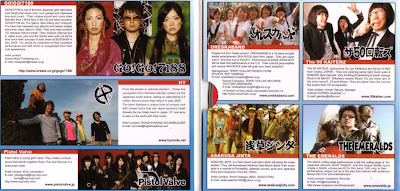
The Return of Japan Nite


Admittedly, the more recent musical excursions found at Japan Nite during SXSW have lost a lot when it comes to the raw sound that had once been unfurled on an unsuspecting populace of music convention attendees. For example, you will note more polish and cleaner recording techniques on this most recent collection of tunes by bands hailing from the warrior nation. There are even songs that appear to be musical reruns of tracks released by other bands on the previous compilations issued in celebration of this annual event. However, this collection isn't without its gems.

The high point on this compilation is the material put together by The Emeralds. The singer's voice, coupled with a rapid staccato singing style that reminds one of the sound of machine gun fire, is something to behold. You'll hear a lot of the same musical influences on this album as those in the past- funk, ska, jazz, Japanese classical music and, of course, balls out alt-rock.


Japan Nite Sound Sampler 2007

Tuesday, October 16, 2007

Pirates or Pissants?


Hear ye! Hear ye!
Captured within yon disk lies pleasure galore. Hear the magnanimous audio engineering skills available in 1989- the dull thud heard repetitiously be not the sound of your failing heart, dear friends, but the off-beat meanderings of the drummer of this raucous ensemble. Though there be no fife present, one can still bask in the glory of yesteryear by sampling these tasty morsels.

These lads hailed from Indianapolis and haunted the local record store, Karma, in search of stoner booty a'plenty. Brazen thievery did sever ties with yon shopkeep but the red-hot muse in their loins spurred them into nostalgic frenzy.


Bear witness to the onslaught. Not for the faint of heart, me lads.

Cheers!

Attitude

Thursday, October 11, 2007

Japanese Flu


After their 1989 tour with New Order and Public Image, The Sugarcubes traipsed to the United States to record their third album. Treating the tour much like they treated their whole musical career, Bjork beamed over the experience: "It was a great tour with no responsibility. We only had to play every other day, and all we had to do was smile at John Lydon when he was puking."

This whimsical attitude spoke itself from the very beginnings of the band's lifespan. As Einar Orn recollects: "We've always done other things, and when all this hullabaloo about the Sugarcubes started, we were 85 per cent doing our paid jobs and 15 per cent doing the Sugarcubes for fun. Then we became the Sugarcubes 100 percent for pay." At the time that the third album was released, they were still working day jobs back home in Iceland.

Derek Birkett, ex-bass player for Flux Of Pink Indians and founder of the record label One Little Indian Records, found their meanderings absolutely exasperating. In an interview, he recounted his working relationship with the band: "Fucking impossible to deal with. I love what they are doing, but they are the only band I've ever worked with for whom the band isn't the priority. That's why they all went off and got jobs. We operate a profit-share, but when they made money they'd blow it in ridiculous ways. Like last year, when they brought out a poetry book which cost £8 to buy and £18 to produce." There was a constancy in this approach to their spending of money. Another example was the night that Bjork walked into a club, handed the bartender her credit card and invited random people throughout the club to have drinks on her tab.

When asked what the title Stick Around For Joy was all about, Siggi, the drummer, chimed in and explained that the title was the result of a phenomenon they encountered while visiting Japan. This phenomenon, dubbed by the band as "Japanese Flu," was a reference to the Japanese habit of speaking English in American advertising slogans such as "have a Coke and a smile." During a drunken card game, the band members were tossing epithets of this sort at one another and Siggi, despondent over a bad hand, blurted out "Stick around for joy" as he threw his cards down on the table.

Tuesday, October 9, 2007

If She Had Nothing More Than Her Voice, She Could Break Your Heart With It


Marlene Dietrich was the first German actress to make it big in Hollywood. Her career as a singer started in Berlin in the 1920s as a cabaret singer and actress. It wasn't until her role as Lola-Lola in The Blue Angel in 1929 that her breakthrough as a world-famous singer materialized with her first popular song Falling In Love Again. Although she detested the song, it became synonymous with her celebrity as a performer.

In the late 1930s, the Nazi Party officially invited her back to the Fatherland but she declined to return. Germany never forgave her for this act, even after the days of the Third Reich had long passed. Her decision to distance herself from her homeland was solidified even further by her recording of anti-Nazi songs such as Lili Marlene.

There are many resources to lean on when reading up on this most revered of international stars. Many recent studies tend to focus on the intentional gender role reversal in her film roles and her manner of dress in the multitude of photographs taken of her. There was a very popular rumor in the day that Marlene Dietrich was a lesbian and this may have been a result of her dear friendship with the famous playwright Noel Coward. Most people had assumed erroneously that the two were an item as a result of their tightly-knit display of friendship, while those who were "in the know" about Coward's sexual leanings had assumed that she was a member of the sexual camp to which he belonged. Recent studies of Coward's journals and writing give no indication that this were the case.

There are many versions of recordings available under this working title. This specific incarnation, released by Hallmark, is currently out of print.

Falling In Love Again

Tuesday, September 25, 2007

prEMO, dude


In the 1990s, it suddenly became musically fashionable to strip down the tenets of hardcore music and use aspects of it to produce profitably safe rock and roll music for the general listening public. The most blatant musical "style" to emanate from this change in approach to marketing music was grunge.

If grunge were to have a red-headed stepchild, its name would be emo.

Although, this writer would much rather remain unschooled in the musical make up of this specific genre, it's safe to say that it's easily identified by its loud, screeching guitars accompanied by EMOtional singing. The unfortunate thing is that it comes off seeming rather foolish; as if somehow these kids who create this music are attempting to mold themselves into a modern-day, hipsteresque, American interpretation of Morrissey but lacking the poetic verse to carry it with the same flavor and character that the ex-Smithy possesses.

However, despite this genre's shortcomings and lack of insight, there can always be an exception to the perceived norm. This exception speaks itself rather loudly in the form of the Chicago trio Today's My Super Spaceout Day. Although, the name of the band is very indicative of this style of musical musing, the engineering quality of the album Stars Made From Scars is phenomenal and the band's live performance equals that. A live performance of the band hints at reminiscence of live acts by bands such as Joy Division but with a modern bent that keeps one plugged into the present. It's the best of both worlds. The mulitple textures and layers of the music itself is something to behold; Areos Ledesma of The Dust Lounge, Christian Adams, and Blaise Barton of Scientific Mastering (not forgetting the musicians themselves!) have created a masterpiece, if anyone could boast some such polyglot about an emo album.

Stars Made From Scars